For Sanford elementary students, the schoolyard became an extension of the classroom this fall thanks to the partnership of Maine Audubon Society and Three Rivers Land Trust.
The organizations collaborated with all three Sanford elementary schools to bring outdoor ecological learning experiences to first- and third-grade students. Through three interactive stations, students connected what they have been learning in the classroom with what they may find in the natural world.
Margaret Chase Smith (MCS) teacher Danielle Goad spoke to the importance of these visits for her students. “MCS has this big, beautiful campus, but much of it would be left undiscovered without [this] partnership,” she commented. She enjoyed helping students connect their preexisting knowledge with experiential practice. “Using the resources we already have to extend our thinking has been really cool,” she added. In the background, students seemed to agree, with one excitedly exclaiming, “we’re never allowed back here!” as he ran toward a previously unexplored corner of the schoolyard.
Witnessing this excitement, Three Rivers Land Trust Executive Director Ruth Gutman shared, “It brought me great pleasure to see how excited the students were to explore new places outside of the usual boundaries of their school playgrounds.” She added,“There is something truly nourishing for children about exploring the woods.”
That enthusiasm was on full display during the organizations’ first visit to Sanford Pride Elementary. Students shrieked and gasped as Maine Audubon’s Wyatt Steffensen revealed glass displays of taxidermied foxes, woodpeckers, and porcupines - all of which, Wyatt made sure to note, had died of natural causes. Students eagerly awaited their turn, hands shooting into the air as they competed to be the first to identify the mystery creature from Wyatt’s clues.
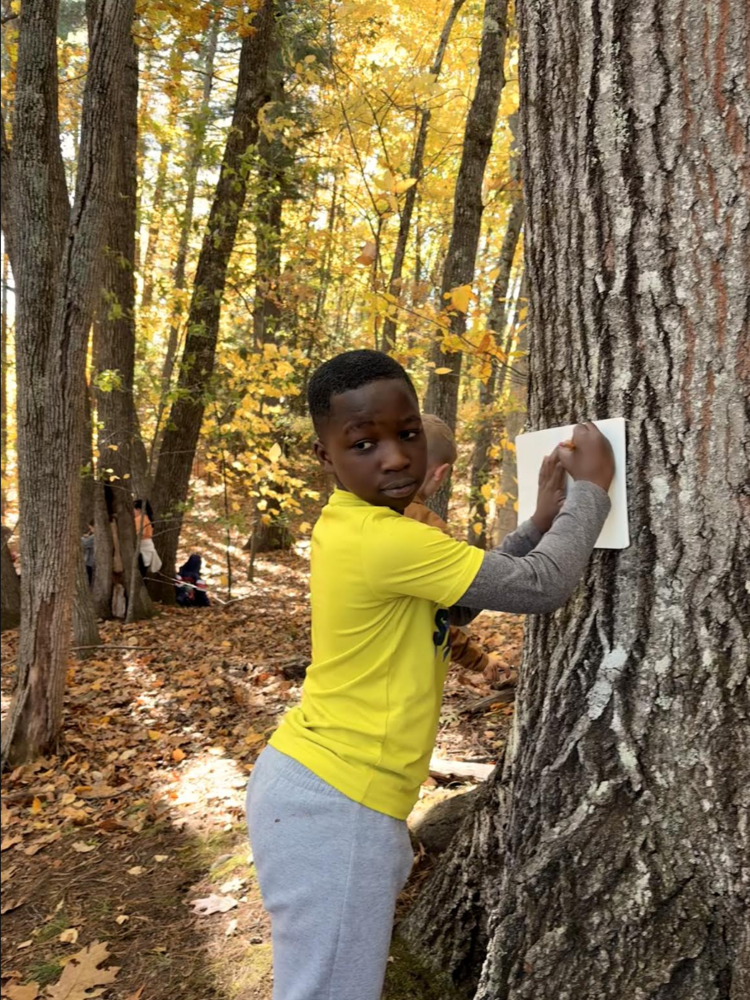
Students also had the opportunity to practice tree identification during the visit, learning the distinct characteristics of maples, birches, or oaks and their leaves - a timely lesson at this time of year. To bolster their learning in a creative way, volunteers sent students on a scavenger hunt, asking them to choose their favorite fallen leaf for a leaf printing activity. With crayons and nature journals in hand, students eagerly got to work, many remarking that the activity was new to them. One student, however, quickly became frustrated when she struggled to get a good imprint with her chosen leaf. When a staff member intervened offering guidance and a new leaf, her experience changed entirely. Beaming with a successful imprint, she shouted, “I’m gonna do this at home!”
Students were then invited to roam the woods with Three Rivers’ Anne MacEachern, where they could engage their boundless curiosity with a few simple guidelines: find things that interest you, show your classmates, and ask questions. Third graders were given more responsibility, asked to draw pictures of their findings and write about their discoveries in nature journals. Students loved the opportunity to learn in their own way, free to share findings with their friends as they roved around, lifting rocks and logs.
“This is fun!” shouted Nolan, a student in Carl J. Lamb (CJL) teacher Sam Noel’s class, though he shrugged his shoulders with a, “not yet,” when discoveries didn’t come quickly. His delight was contagious as one friend announced the presence of a worm, drawing the entire class around to see the creature snug beneath a log.
While these fall experiences were the first installment of Three Rivers’ and Maine Audubon’s visits to Sanford elementary students, the initiative grew from an existing partnership with Diana Allen, Life & Environmental Science Teacher at Sanford Middle School. A board member for the Maine Science Teacher Association (MSTA), Diana has spent the past decade seeking hands-on, outdoor educational science opportunities for younger students, even hosting collaborative science days that invite elementary school students to join her own middle school students as they learn.
Maine Audubon has worked alongside Diana for several years, leading activities focused on macroinvertebrates and water quality testing. Three Rivers joined the partnership more recently, helping secure volunteers and expand the reach of these efforts. Through that collaboration, Diana’s students even gained another opportunity to work with Three Rivers in establishing a Climate Change Observatory Network (CCON) site at Stump Pond (see here).
Expanding the partnership to engage Sanford elementary schools was a joint effort among Diana, Maine Audubon, Three Rivers, and Sanford School Department Director of Curriculum Beth Lambert, who Diana credited as instrumental in making the idea a reality. Together, they were able to extend hands-on learning experiences to a younger generation of Sanford students.
The organizations are looking forward to returning in the coming winter and spring, giving students the opportunity to compare and contrast familiar places, observe seasonal changes, and compound their understanding from previous visits. As they prepare, Three Rivers and Maine Audubon are seeking additional community volunteers. Ruth Gutman encourages “any folks in the community with a love for nature and a passion for education to consider volunteering with us to lead these outdoor programs.” Whether an educator or simply someone excited about outdoor experiences and youth education, community members can have a meaningful impact on Sanford students' learning.
Together with all of the Sanford schools staff who orchestrated these visits, Maine Audubon Society and Three Rivers Land Trust are helping turn familiar schoolyards into places of discovery, showing students that there is always something new to learn about the natural world.
And perhaps, the next time a fox crosses a student's path, they’ll remark on the size of its ears or the point of its nose, prompting a curious mind to see even the most familiar encounters as wonders waiting to be explored.