
On April 7, roughly 1,000 students from approximately 100 schools across Maine will file into the Augusta Civic Center, sit down in near silence, and race to solve some of the most challenging math problems they've seen all year. Sanford High School's Math Team will be among them, and they're ready. The team practices every Tuesday after school under the guidance of Kailee Colbeth and Adam Soule. Those sessions are built around doing practice problems that closely resemble what students will actually see at meets. SHS junior captains Nathan Maloney and Hannah Labbe say the consistency of this year's group has made a real difference.  "We've had a lot of the same people showing up, so you can really start to get into a groove and have better team rounds," said Maloney. "We've definitely seen a lot more success this year." Labbe agreed, adding that the experience has been personally rewarding as well. "It's really been fulfilling to succeed in all of the meets," she said. "I feel like I've learned a lot and I'm just going to carry it forward." That success has shown up throughout the regular season. The team has competed in five meets leading up to states, and Colbeth says the squad has grown stronger as the year has gone on. At a typical meet, students compete in five separate rounds, each focused on a specific math topic like trigonometry or statistics. Each round gives students 12 minutes to answer three questions. There's also a round where the whole team works together. Individual and team scores are added up, though only the top performers count toward the final tally. The state meet adds one more challenge that the team has been practicing: a relay round. Five students sit in a row, each with their own math problem to solve. The catch is that each person's answer gets passed to the next teammate, whose problem depends on getting that answer right.  "It's something we don't do in normal meets," said Colbeth, "so we've really been focused on it these last few weeks, figuring out who is going to be best in each seat." It's a format that rewards both individual skill and trust in your teammates, and one that has the team thinking carefully about how they line up heading into the state competition. Both Labbe and Maloney competed at last year's state meet and say knowing what to expect will make a big difference. "The first time you go there, it can be kind of stressful, since it's a big auditorium with a lot of people," said Maloney. "But I think this year will be a lot easier." Labbe, put it simply: "I was going into it really blind. I learned so much. I feel like I'm able to take more out of it this year." Coach Colbeth said that the math team is open to all students. Practices resume on Tuesdays next school year. Students interested in joining are encouraged to stop by and see her.

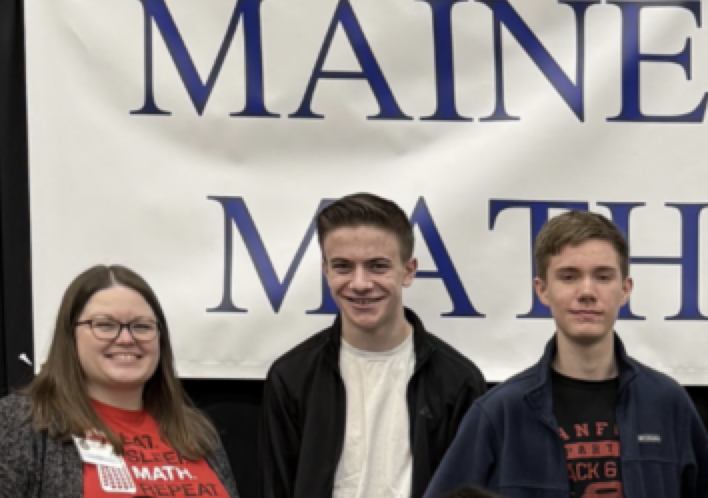
On April 7, roughly 1,000 students from approximately 100 schools across Maine will file into the Augusta Civic Center, sit down in near silence, and race to solve some of the most challenging math problems they've seen all year. Sanford High School's Math Team will be among them, and they're ready.

The team practices every Tuesday after school under the guidance of Kailee Colbeth and Adam Soule. Those sessions are built around doing practice problems that closely resemble what students will actually see at meets. SHS junior captains Nathan Maloney and Hannah Labbe say the consistency of this year's group has made a real difference. 

"We've had a lot of the same people showing up, so you can really start to get into a groove and have better team rounds," said Maloney. "We've definitely seen a lot more success this year." Labbe agreed, adding that the experience has been personally rewarding as well. "It's really been fulfilling to succeed in all of the meets," she said. "I feel like I've learned a lot and I'm just going to carry it forward."

That success has shown up throughout the regular season. The team has competed in five meets leading up to states, and Colbeth says the squad has grown stronger as the year has gone on.

At a typical meet, students compete in five separate rounds, each focused on a specific math topic like trigonometry or statistics. Each round gives students 12 minutes to answer three questions. There's also a round where the whole team works together. Individual and team scores are added up, though only the top performers count toward the final tally.

The state meet adds one more challenge that the team has been practicing: a relay round. Five students sit in a row, each with their own math problem to solve. The catch is that each person's answer gets passed to the next teammate, whose problem depends on getting that answer right. 

"It's something we don't do in normal meets," said Colbeth, "so we've really been focused on it these last few weeks, figuring out who is going to be best in each seat." It's a format that rewards both individual skill and trust in your teammates, and one that has the team thinking carefully about how they line up heading into the state competition.

Both Labbe and Maloney competed at last year's state meet and say knowing what to expect will make a big difference. "The first time you go there, it can be kind of stressful, since it's a big auditorium with a lot of people," said Maloney. "But I think this year will be a lot easier." Labbe, put it simply: "I was going into it really blind. I learned so much. I feel like I'm able to take more out of it this year."

Coach Colbeth said that the math team is open to all students. Practices resume on Tuesdays next school year. Students interested in joining are encouraged to stop by and see her.