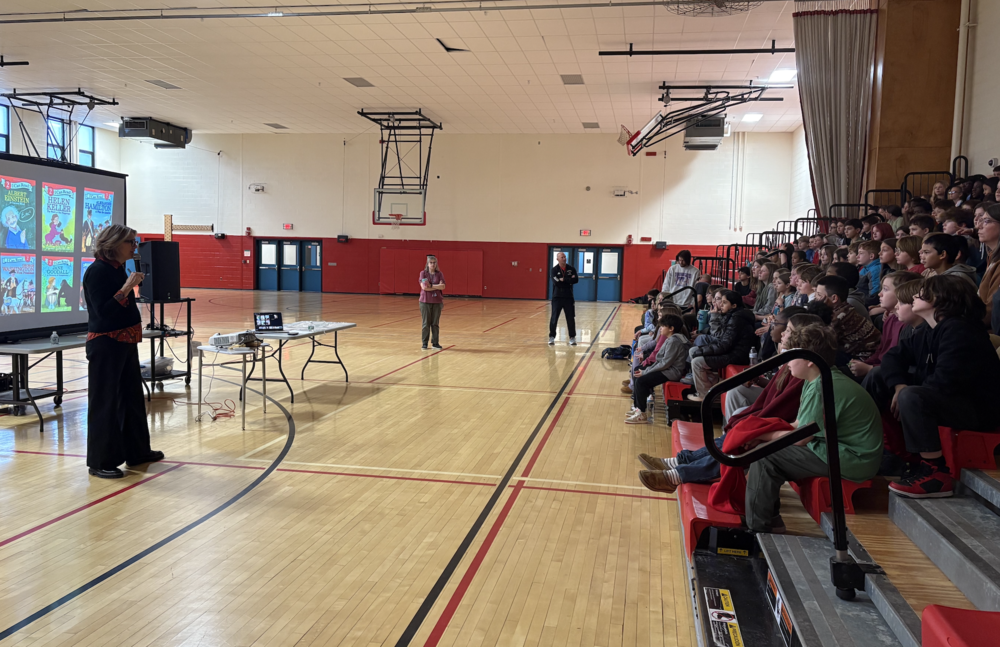
Students at Sanford Middle School were treated to a visit from New York Times bestselling author Sarah Albee, who shared her passion for nonfiction writing.
Albee, who has written numerous books for middle grade readers including Why'd They Wear That?, and Accidental Archaeologist, met with each grade level in the gymnasium for 50-minute sessions. During these presentations, she pulled back the curtain on her writing process, demonstrating how writers make countless choices about what to include, where to start a story, and how to make complex topics accessible to young readers.
Using her biography of George Washington as an example, Albee invited student volunteers to become "human note cards," arranging them to show how she structures her books. The demonstration revealed that good writing isn't just about gathering facts, it's about deciding which details matter most and organizing them in a compelling way. Students were surprised to learn that her 24-page picture book required just as much research as her longer works, but demanded even more careful decision-making about what to include.
The presentation sparked plenty of curiosity from students. "How do you go to the bathroom in a suit of armor?" one student asked, referencing Albee's book about historical fashion and daily life. Another wanted to know, "What's your name?" in Arabic, after learning about Albee's year living in Cairo.
Later in the afternoon, Albee met with student medallion holders in the library for two half-hour question and answer sessions. These gatherings allowed students to dive deeper into both her writing life and personal experiences. Questions ranged from practical inquiries about how long it takes to write a picture book to personal questions about what it was like living in Egypt.
When asked about her favorite book to write, Albee shared her enthusiasm for Fairy Tale Science, which allowed her to work with fifth grade classes across the country who tested her experiments. Students also learned that she's currently juggling multiple projects at once—a necessity in children's publishing where illustrators may take months or even years to complete artwork.
One student wanted to know what it's like being an author. Albee explained that while people don't recognize her on the street, the job comes with its own challenges, including rejections and the frustrations of the long publishing timeline..
Throughout the day, Albee emphasized the importance of revision, showing students that professional writers often produce many drafts before sharing their work. She encouraged students to view teachers' feedback as a gift, explaining that detailed comments show teachers care enough to invest time in helping students improve.